Data sovereignty for enterprise AI in 2026: matching infrastructure deployment models to legal boundaries and subprocessor chains.
Data Sovereignty in 2026 and Why AI Infrastructure Location Matters
Published on June 29th, 2026
Selecting a European server region in a dropdown menu does not satisfy data sovereignty requirements. For Data Protection Officers (DPOs) and Chief Information Security Officers (CISOs), deploying enterprise AI in 2026 requires distinguishing between simple data localization and true jurisdictional sovereignty.
As employees feed internal documents and customer records into frontier AI models, protecting sensitive corporate data requires evaluating infrastructure location, legal exposure under foreign statutes, subprocessor transparency, and active data protection controls.
Understanding the Technical Reach of the US CLOUD Act
Physical server location in Frankfurt or Dublin does not shield data from foreign legal demands if the provider is subject to US jurisdiction. Under the US CLOUD Act (18 U.S.C. § 2713), US authorities can compel US technology providers to disclose data under their possession, custody, or control, regardless of server location1.
This reality was highlighted in French Senate testimony, where a Microsoft France executive acknowledged under oath that the company could not guarantee French citizen data hosted locally would never be transmitted to US authorities without French government agreement2. Cloud contracts promising "EU data storage" remain legally subservient to the parent company's home jurisdiction.
The Ongoing Legal Uncertainty of the Data Privacy Framework
Data transfers between the EU and the US continue to face structural legal uncertainty. Following prior invalidations of Safe Harbor and Privacy Shield, organizations currently rely on the 2023 EU-US Data Privacy Framework (DPF).
While the EU General Court dismissed an initial challenge to the DPF, that ruling was appealed to the Court of Justice of the European Union (CJEU) in October 2025 under Case C-703/25 P3. While the DPF remains in force pending appeal, compliance officers cannot treat it as a permanent foundation.
Bitkom research underscores this concern: 87% of German enterprises cite insufficient processing transparency as a primary obstacle when selecting cloud and AI services, while 82% desire technical independence from foreign infrastructure4.
Evaluating the Four Tiers of Enterprise AI Deployment
Organizations evaluating enterprise AI platforms must choose an infrastructure deployment model that matches their risk tolerance and regulatory obligations.
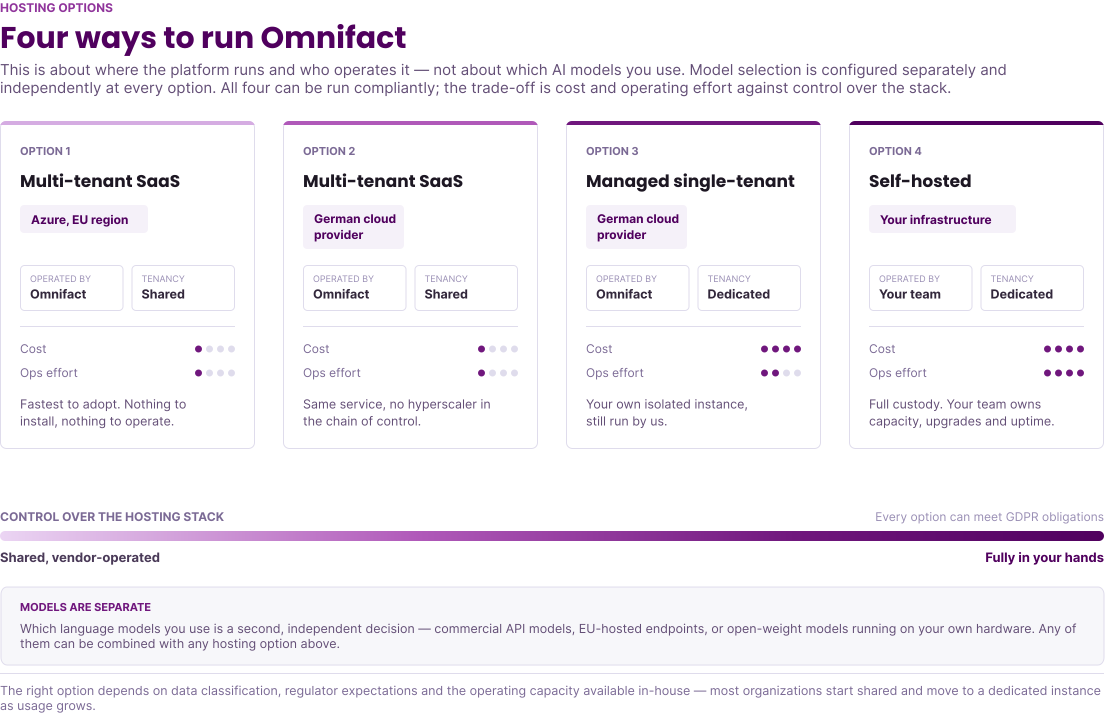
Tier 1: Multi-Tenant EU SaaS
Standard SaaS offerings host multi-tenant application layers in European datacenters. While cost-effective, data processing paths often involve shared infrastructure and US parent corporations.
Tier 2: Dedicated EU Cloud and Vertex AI Residency
Deployments leveraging dedicated EU infrastructure, such as Vertex AI EU Data Residency, route requests through dedicated European boundaries for Google Gemini and Anthropic Claude models, keeping prompts, embeddings, and outputs strictly within the region.
Tier 3: EU Sovereign Cloud
Infrastructure owned and governed entirely by European entities eliminates cross-border legal exposure under foreign statutes, meeting strict sovereign procurement guidelines.
Tier 4: Self-Hosted On-Premise
For organizations requiring total isolation, self-hosting LLMs inside private infrastructure provides complete control over hardware, model weights, and network perimeters.
| Deployment Tier | Infrastructure Hosting | Legal Jurisdiction | CLOUD Act Exposure | Primary Ideal Use Case |
|---|---|---|---|---|
| Tier 1: Multi-Tenant EU SaaS | Public cloud in EU regions (e.g., Frankfurt) | Vendor home jurisdiction (US parent or EU entity) | Applicable if parent entity is US-based | Standard corporate productivity and non-sensitive business workflows |
| Tier 2: Dedicated EU Cloud / Vertex AI Residency | Isolated EU cloud instances (e.g., Google Vertex AI EU Data Residency) | EU-bounded regional data processing | Mitigated via regional isolation and contractual controls | Regulated enterprise workloads requiring frontier AI models |
| Tier 3: EU Sovereign Cloud | European-owned and operated infrastructure | Strictly European jurisdiction | Non-applicable (no US parent entity control) | Highly regulated public sector, healthcare, and critical infrastructure |
| Tier 4: Self-Hosted On-Premise | Private data centers or air-gapped infrastructure | Local organization jurisdiction | Fully eliminated | Confidential R&D, banking, core government, and strict isolation requirements |
Technical Controls That Guard Enterprise Data Streams
Jurisdictional choices must be paired with active technical safeguards embedded directly into the data path.
Zero Data Retention (ZDR)
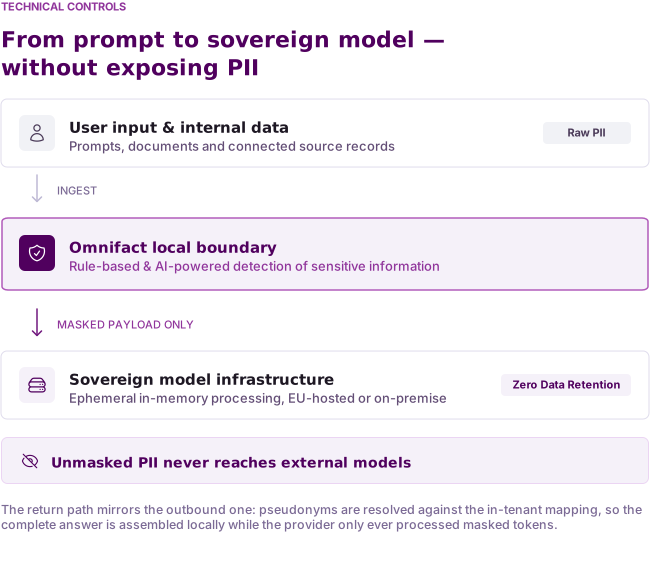
Zero Data Retention guarantees that models process API requests ephemerally in memory without writing inputs or outputs to persistent disk, log files, or training sets.
Active PII Pseudonymization
Before data reaches an external AI model, sensitive information should be redacted at the edge. Omnifact's Privacy Filter uses rule-based and AI-powered detection to pseudonymize personal data within the local application boundary before transmission. Original values map back locally, ensuring third-party providers never receive unmasked identifiers.
Subprocessor Transparency
Compliance frameworks require complete auditability of subprocessor chains. Organizations must verify whether model providers engage secondary vendors for logging, moderation, or vector indexing.
A Practical Governance Checklist for DPOs and CISOs
When assessing an enterprise AI platform, compliance and security leads should verify five core criteria:
- Jurisdictional Reach: Identify the ultimate parent company of every vendor and subprocessor in the processing chain.
- Data Retention Guarantees: Obtain contractual Zero Data Retention commitments prohibiting model training on customer inputs.
- Pre-Execution Protection: Implement automated detection to pseudonymize personal data before model transmission.
- Processing Boundaries: Verify whether model inference and vector retrieval occur within designated European regions.
- Deployment Flexibility: Ensure the platform supports multi-model selection and self-hosted options as regulatory requirements evolve under the EU AI Act.
Evaluating enterprise AI against these criteria establishes a defensible governance posture while giving employees secure access to modern AI capabilities. For a broader architecture comparison, explore our guide on evaluating enterprise AI platforms.